

Pickleball Serve Rules: Legal Serves, Faults and How to Serve (2026)
Learn every pickleball serve rule: volley and drop serves, where to stand, where the ball must land, and the faults that lose you the point, from the 2026 rulebook.
In this guide
- Before you serve: score and timing
- Where to stand (7.A)
- Two legal serves
- The volley serve (7.C)
- The drop serve (7.D)
- The release: what you may and may not do with spin (7.B)
- Where the serve must land (7.E)
- What happens after a serve fault
- What changed in 2026
- The most common serve mistakes
- Tips for a reliable serve (practical, not official rules)
- Related guides
- Sources
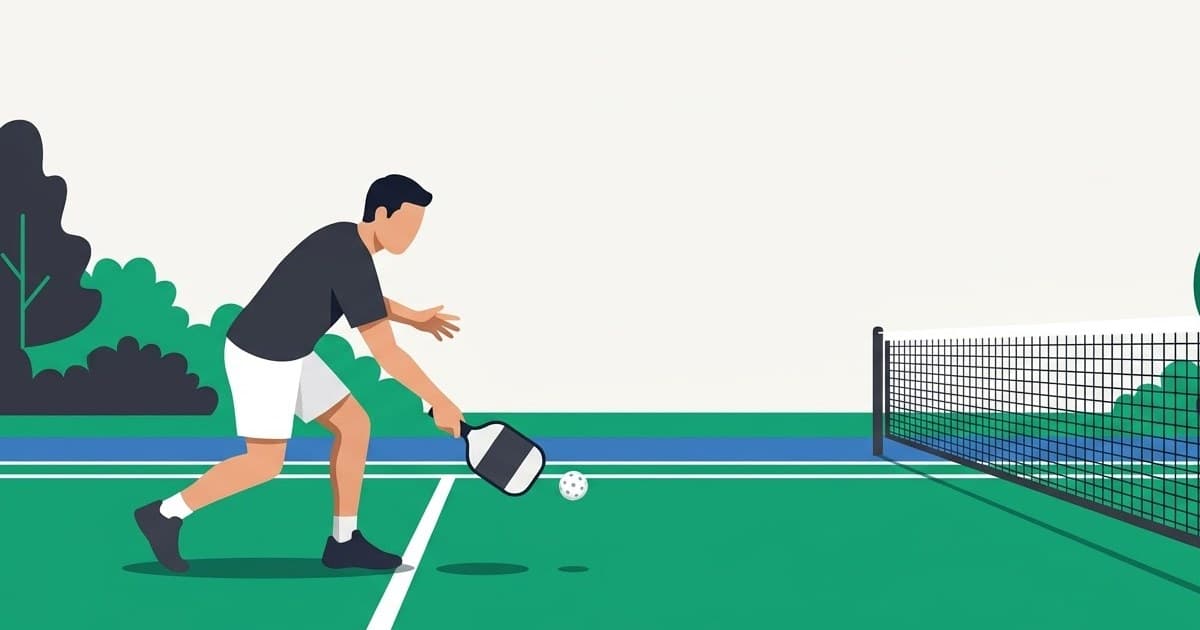
The serve starts every rally, so it is the first rule new players have to get right. The good news is that the serve rules fit on one page. Here is the short version, then each rule in detail.
- Call the whole score first, then serve within 10 seconds.
- Stand behind the baseline, in your correct serving area, with at least one foot grounded.
- Hit the ball with a volley serve or a drop serve.
- Serve diagonally: over the net, past the kitchen, into the correct service court.
- If it lands out, in the kitchen, or you break a rule, it is a fault and the serve is lost.
Where these rules come from
This guide follows the 2026 USA Pickleball Official Rulebook (effective January 1, 2026). Rule numbers in brackets, like (7.C.1), come from it. You can read the full text on the official USA Pickleball rules page. I am not a referee, and your local group may play house rules.
Before you serve: score and timing
- Call the entire score first. If the server hits the ball while the score is still being called, it is a fault against the server (6.C.1). The server normally calls the score (6.B).
- Serve within 10 seconds after the score call is finished. If you do not, it is a fault (6.D.1).
- Be ready. Before the score call starts, any player may signal they are not ready by raising a paddle or their free hand above their head, or by turning their back to the net (6.A.1).
For how the score call works, see my pickleball scoring guide.
Where to stand (7.A)
- At least one foot must be in contact with the correct serving area when you hit the ball (7.A.1). If both feet are off the playing surface, it is a fault.
- Neither foot may touch the court (on or inside the baseline) when you hit it (7.A.2).
- Neither foot may touch the playing surface outside your serving area. The serving area is the zone behind the baseline between the imaginary extensions of the sideline and the centerline (7.A.3, 3.A.4.g).
In short: stay behind the baseline, stay between the extended lines, and do not jump both feet into the air.
Two legal serves
You can use either serve, and you can switch from one to the other on any serve.
The volley serve (7.C)
You hit the ball out of the air without bouncing it. The motion has to meet three tests, and the 2026 rulebook says each must be clear:
| Test | Rule | What it means |
|---|---|---|
| Upward arc | 7.C.1 | The paddle is moving in a clear upward arc when it contacts the ball. |
| Paddle head | 7.C.2 | The highest point of the paddle head is clearly not above the highest part of your wrist joint. |
| Ball height | 7.C.3 | The ball is clearly no higher than your waist. |
A volley serve can be a forehand or a backhand (7.C.4). If you break any of the three tests, it is a fault (7.C.5). A "flat" serve with no upward arc is not legal.
The drop serve (7.D)
You drop the ball and hit it after it bounces. The rules for the drop are simple:
- Release the ball from a natural height without help (7.D.1).
- Do not throw or propel it in any direction before you hit it (7.D.2).
- There is no limit on how many times it bounces, or where, before you hit it (7.D.3, 7.D.4).
- None of the volley-serve limits apply, so contact height and paddle position are unrestricted.
If you are new, the drop serve is the easiest way to get a legal serve in play. It is also fully legal at every level.
The release: what you may and may not do with spin (7.B)
- Release the ball using only one hand or only the paddle (7.B.1).
- You may not manipulate the ball to add spin with any part of your body or paddle before you hit it, except that you may let the ball roll off the paddle face by gravity (7.B.2).
- You may add spin when the paddle contacts the ball. The rulebook says spin may be applied upon contact by the paddle (7.B.2).
- The receiver must be able to see the release (7.B.3). If the receiver determines you added spin on the release, or could not see it, they may call for a replay, but only before returning the serve (7.B.2.a, 7.B.3.a).
The 2026 change document calls this one of the most misunderstood rules: spin from the paddle at contact is allowed, spin from your hand at release is not.
Where the serve must land (7.E)
You serve to the service court diagonally opposite your correct position (7.E). The ball must:
- Clear the opponent's non-volley zone (the kitchen), and
- Land in the correct service court, which includes its lines (8.B).
It may touch the net on the way: the rule says "with or without touching the net" (7.E). A serve that clips the net and lands in the right court is simply good, with no let and no replay.
Everything that makes a serve out:
| What happens | Result | Rule |
|---|---|---|
| Lands outside the correct service court | Fault against server | 7.E.1 |
| Lands in the kitchen, including on the kitchen line | Fault against server | 7.E.2, 8.C |
| Hits a permanent object before landing | Fault against server | 7.E.3 |
| Hits the server or the server's partner, or anything they wear or carry | Fault against server | 7.E.4 |
| Hits the receiver or receiver's partner, or anything they wear or carry, before landing | Fault against the receiver | 7.E.5 |
The last row is worth remembering: if your serve hits the receiving team before it lands, you win the rally.
What happens after a serve fault
A fault ends the rally. In doubles the serve goes to your partner if you are the first server, or to the other team if both servers have served (5.B). In singles it goes straight to your opponent (5.A.3). There is no "second serve" like in tennis.
What changed in 2026
The 2026 rulebook tightened two serving rules, according to the official change document:
- "Clearly" was added to the volley-serve tests (upward arc, paddle head, ball height), which makes borderline serves easier for referees to call a fault.
- The spin rule was reworded to say that spin from the paddle at contact is legal, and manipulating the ball during the release is not.
See my guide to the 2026 rule changes for the rest.
The most common serve mistakes
- Serving before the score call is finished (6.C.1).
- Stepping on the baseline or inside the court when you hit the ball (7.A.2).
- A flat volley serve with no clear upward arc, or contact above the waist (7.C).
- Serving into the kitchen or onto its line (7.E.2).
- Serving to the wrong court after a side out, because you forgot the score or your side.
Tips for a reliable serve (practical, not official rules)
- Start with the drop serve. The bounce gives you a consistent release.
- Aim for depth. A serve that lands near the baseline is a harder return, but clearing the kitchen is the only requirement for being in.
- Pick a target. Aim at the middle of the service court first, then adjust.
- Use the same routine every time. It helps you stay inside the 10-second limit.
Related guides
- New to the game? Read pickleball rules for beginners.
- Confused about the kitchen? See the pickleball kitchen rules.
Sources
- USA Pickleball, Official Rulebook (2026 edition): Sections 5 (serving sequence), 6 (calling the score), 7 (serving), and 8 (line calls).
- USA Pickleball, 2026 Rulebook Change Document: entries on the "clearly" wording (volley serve) and the spin-on-release rule.
Last checked against the 2026 rulebook in October 2026. I will update this guide when USA Pickleball publishes a new edition.
Frequently asked questions
Does a pickleball serve have to be underhand?
The rulebook does not use the word underhand. A volley serve must be hit with the paddle moving in a clear upward arc, the paddle head clearly not above the wrist, and the ball clearly no higher than the waist at contact. A drop serve lets the ball bounce first and has no limits on paddle motion or contact height.
Can a serve touch the net in pickleball?
Yes. The serve must clear the opponent's non-volley zone, with or without touching the net, and land in the correct service court. There is no let serve to replay.
Is a serve that lands on the kitchen line in?
No. A serve that lands in the non-volley zone, including on the kitchen line, is out and is a fault against the server. A serve that lands on the other lines of the correct service court is in.
Can I put spin on my serve?
You can apply spin with the paddle when it contacts the ball. You may not manipulate the ball to add spin with your hand, body or paddle while releasing it, apart from letting it roll off the paddle face by gravity.
How long do I have to serve after the score is called?
The server must serve within 10 seconds after the score call is completed, and the whole score must be called before the serve is hit.
Do I get a second serve if I fault?
No. A serve fault ends the rally. In doubles the serve then passes to the second server, or to the other team if both servers on your team have served.
Keep reading
Pickleball Rules for Beginners: The Simple Guide (2026 Rules)
Learn pickleball in plain English: the court, serving, the two-bounce rule, the kitchen, faults and scoring, based on the 2026 USA Pickleball rulebook.
Pickleball Scoring Explained: How to Keep Score (With Examples)
Confused by “zero-zero-two”? Learn how pickleball scoring works: who scores, the three-number call, server one and two, side outs and singles, step by step.
Pickleball Kitchen Rules: What You Can and Can't Do in the Non-Volley Zone
Kitchen faults trip up most new players. Learn exactly what the non-volley zone rule allows, how the momentum rule works, and how to avoid the common mistakes.