Pickleball Rules for Beginners: The Simple Guide (2026 Rules)
Learn pickleball in plain English: the court, serving, the two-bounce rule, the kitchen, faults and scoring, based on the 2026 USA Pickleball rulebook.
In this guide
Pickleball looks complicated for about five minutes, then it clicks. Here is the whole game in five lines:
- The serve goes diagonally into the opposite service court.
- Each side lets the ball bounce once before hitting it (the two-bounce rule).
- You cannot volley (hit the ball out of the air) while touching the kitchen, the 7-foot zone next to the net.
- In standard play, only the serving side scores.
- Typically the first side to 11 points with a 2-point lead wins.
The rest of this guide explains each rule and shows where it comes from, so you can check it yourself.
Where these rules come from
Everything below follows the 2026 USA Pickleball Official Rulebook (effective January 1, 2026). Rule numbers in brackets, like (7.E), are from that rulebook, so you can look them up on the official USA Pickleball rules page. I am not a referee. Local recreational groups sometimes play house variations, and USA Pickleball updates its rulebook periodically, so check that you are reading the current edition.
The court in 60 seconds
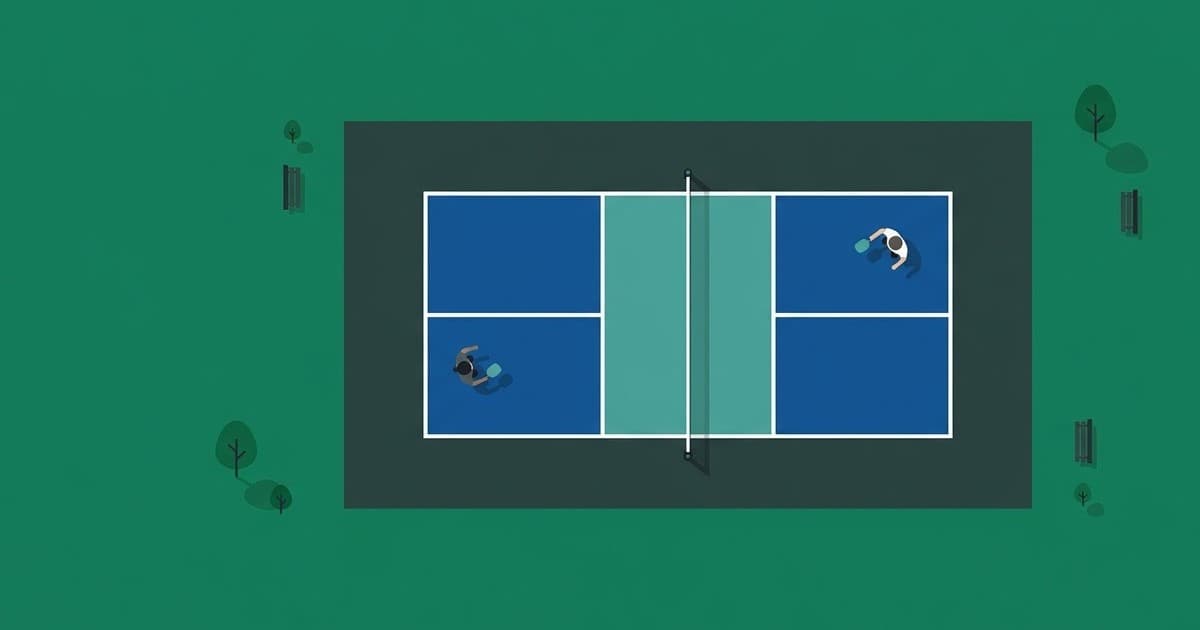
A pickleball court is the same size for singles and doubles. The numbers below are from Section 3 of the rulebook.
| Item | Official measurement | Rule |
|---|---|---|
| Court | 20 ft wide by 44 ft long | 3.A.1 |
| Kitchen (non-volley zone) | 7 ft from the net on each side, full width of the court | 3.A.4.c |
| Net height at the sidelines | 36 inches | 3.B.6 |
| Net height at the center | 34 inches | 3.B.7 |
| Lines | About 2 inches wide, all the same color | 3.A.4.e |
Two details matter right away. The lines around the kitchen are part of the kitchen (3.A.4.c), and the centerline runs from the kitchen line to the baseline, splitting the area behind it into the left and right service courts (3.A.4.d).
How to serve
The server stands behind the baseline and hits the ball to the service court that is diagonally opposite (7.E). Rules for the serve:
- Where it must land: the served ball must clear the opponent's kitchen, with or without touching the net, and land in the correct service court (7.E). Landing on the kitchen line counts as out (8.C).
- Your feet: at least one foot must be in contact with the correct serving area, and neither foot may touch the court itself (on or inside the baseline) when you hit the ball (7.A).
- The release: you may release the ball with one hand or just the paddle, and you must not add spin to the ball with your hand or paddle before you hit it. The ball may roll off the paddle face by gravity (7.B).
- Two legal styles: the volley serve or the drop serve. You can choose either on each serve.
The volley serve (7.C)
You hit the ball out of the air, and the motion must meet three tests, each of which has to be clear:
- The paddle is moving in a clear upward arc when it hits the ball.
- The highest part of the paddle head is not above your wrist joint at contact.
- The ball is no higher than your waist at contact.
A volley serve can be a forehand or a backhand. If any of the three tests is not met, it is a fault.
The drop serve (7.D)
You drop the ball from a natural height (no throwing it down) and hit it after it bounces. There is no limit on how many times it bounces before you hit it, and the volley-serve restrictions do not apply. If you are new, the drop serve is the easiest way to get a legal serve started.
The two-bounce rule
This is the rule that makes pickleball rallies last (10.A):
- The serve must bounce before the receiver hits it.
- The receiver's return must bounce before the serving side hits it.
- After that, either side can hit the ball in the air (volley), as long as they are not breaking the kitchen rule.
If the receiver hits the serve out of the air, it is a fault against the receiver (10.A.1). If the serving side hits the return out of the air, it is a fault against the serving side (10.A.2). Separately, a player must return any ball before it bounces twice on their side (10.B).
The kitchen (non-volley zone)
The kitchen trips up almost every new player, so here is the short version. You can stand in the kitchen any time, but you cannot volley while you or anything you are carrying or wearing touches it (11.A). Your momentum counts as part of the volley (11.A.2). The full explanation, with examples, is in my pickleball kitchen rules guide.
What counts as a fault
A fault ends the rally and you lose it. Common faults for beginners, with the rule that covers each:
| Fault | Rule |
|---|---|
| Serve lands outside the correct service court | 7.E.1 |
| Serve lands in the kitchen | 7.E.2 |
| Illegal volley serve (no clear upward arc, paddle head above the wrist or ball above the waist) | 7.C.5 |
| Receiver volleys the serve, or the serving side volleys the return | 10.A.1, 10.A.2 |
| Letting the ball bounce twice before you return it | 10.B.1 |
| Hitting the ball out of bounds | 10.C.1 |
| Hitting the ball into the net so it does not cross | 10.C.2 |
| Ball hits you or your clothing after the serve, apart from your paddle and hand below the wrist | 10.C.3 |
| Volleying while touching the kitchen | 11.A.1 |
| Hitting the ball twice in a non-continuous motion, or both partners hitting it | 10.D.1, 10.D.2 |
| Stopping a live rally yourself (unless calling a hinder, a position error or a wrong score) | 9.A.1 |
You are expected to call faults on yourself as soon as you notice them (9.B.2). In standard play you cannot enforce other faults on your opponents, with two exceptions that players may call: kitchen faults and serving foot faults (9.B.3 and 9.B.4). For anything else you may mention the fault after the rally, but the final decision belongs to the player who allegedly committed it.
Line calls
Players call the lines on their own end of the court (8.A). The key rules:
- A ball touching a line is in. A ball that lands on the opponent's end of the court counts as in (8.B).
- The only exception is a serve that lands in the kitchen, including on the kitchen line: that is out (8.C).
- You must see daylight. Do not call a ball out unless you can clearly see a space between the line and the ball (8.E).
- Doubt goes to your opponent. If you cannot promptly call a ball out, it is in (8.D).
- Call it quickly by voice or a clear hand signal (8.F). In doubles, if partners disagree, the call is in (8.H).
Scoring in one minute
- In standard play you score a point only when your side is serving and wins the rally (4.A).
- In doubles, the score is called as three numbers: your team's score, the other team's score, then the server number (6.B.2). The game starts at "zero, zero, two" (6.B.2).
- A server keeps serving until losing a rally. In doubles, both partners serve before the serve passes to the other team, except at the very start of a game, when only one player serves (5.B).
- In singles, you serve from the right side when your score is even and the left when it is odd (5.A.1).
My pickleball scoring guide walks through a full example, rally by rally.
Singles or doubles?
The court is the same size for both (3.A.1). Doubles is more social and easier to start with, because you share the court, and rallies tend to be longer. Singles is a bigger workout and the serving rules differ slightly (see the scoring section above).
Your first game: a quick checklist
- Check the net is about 36 inches high at the sides.
- Agree who serves first, and agree the score call out loud before every serve.
- Use a drop serve if you are nervous about the volley serve.
- Remember the two bounces at the start of every rally.
- Stay behind the kitchen line when you hit the ball out of the air.
- Be generous on line calls. Doubt goes to your opponent.
- Check you have a paddle that is allowed: see my paddle buying guide.
Common beginner mistakes
- Volleying the serve return (breaking the two-bounce rule).
- Standing in the kitchen and volleying, or stepping in with momentum after a volley.
- Serving into the kitchen or onto its line.
- Forgetting to call the score before serving. The whole score has to be called before the serve is hit, or it is a fault (6.C).
- Calling "out" on a close ball. If you cannot clearly see a gap, it is in.
Sources
- USA Pickleball, Official Rulebook (2026 edition, effective January 1, 2026). All rule numbers above come from this edition. The rulebook is the authority, so check it if a rule matters for your event.
- USA Pickleball, 2026 Rulebook Change Document, which lists what changed from 2025 and why.
Last checked against the 2026 rulebook in October 2026. I will update this guide when USA Pickleball publishes a new edition.
Frequently asked questions
How many players are in a pickleball game?
Pickleball can be played as singles (one player per side) or doubles (two players per side). Doubles is the most common format at recreational courts.
How do you win a game of pickleball?
In standard scoring, you score only when your side is serving and wins the rally. The official rulebook says that typically the first player or team to score 11 points and lead by at least 2 wins the game. Tournaments can use other targets, such as 15 or 21.
Does the serve have to be underhand?
The rulebook allows two kinds of serve. A volley serve must be hit with a clear upward arc, the paddle head not above the wrist, and the ball no higher than the waist at contact. A drop serve lets the ball bounce first and has no restrictions on paddle motion or contact height.
Can a serve touch the net?
Yes. The serve must clear the opponent's non-volley zone, with or without touching the net, and land in the correct service court.
What is the two-bounce rule?
After the serve, the receiving side must let the ball bounce before returning it, and then the serving side must let the return bounce before hitting it. After those two bounces, players may volley (hit the ball out of the air) outside the kitchen.
What is the kitchen in pickleball?
The kitchen is the non-volley zone: the 7-foot area on each side of the net. You may stand in it, but you cannot hit a ball out of the air while you are touching it.
Keep reading
Pickleball Scoring Explained: How to Keep Score (With Examples)
Confused by “zero-zero-two”? Learn how pickleball scoring works: who scores, the three-number call, server one and two, side outs and singles, step by step.
Pickleball Kitchen Rules: What You Can and Can't Do in the Non-Volley Zone
Kitchen faults trip up most new players. Learn exactly what the non-volley zone rule allows, how the momentum rule works, and how to avoid the common mistakes.

Best Pickleball Paddles of 2026: How to Choose and Top Picks by Player Type
Which pickleball paddle should you buy? Learn how core, weight and shape change your game, then see 2026 picks by player type from independent tests.